
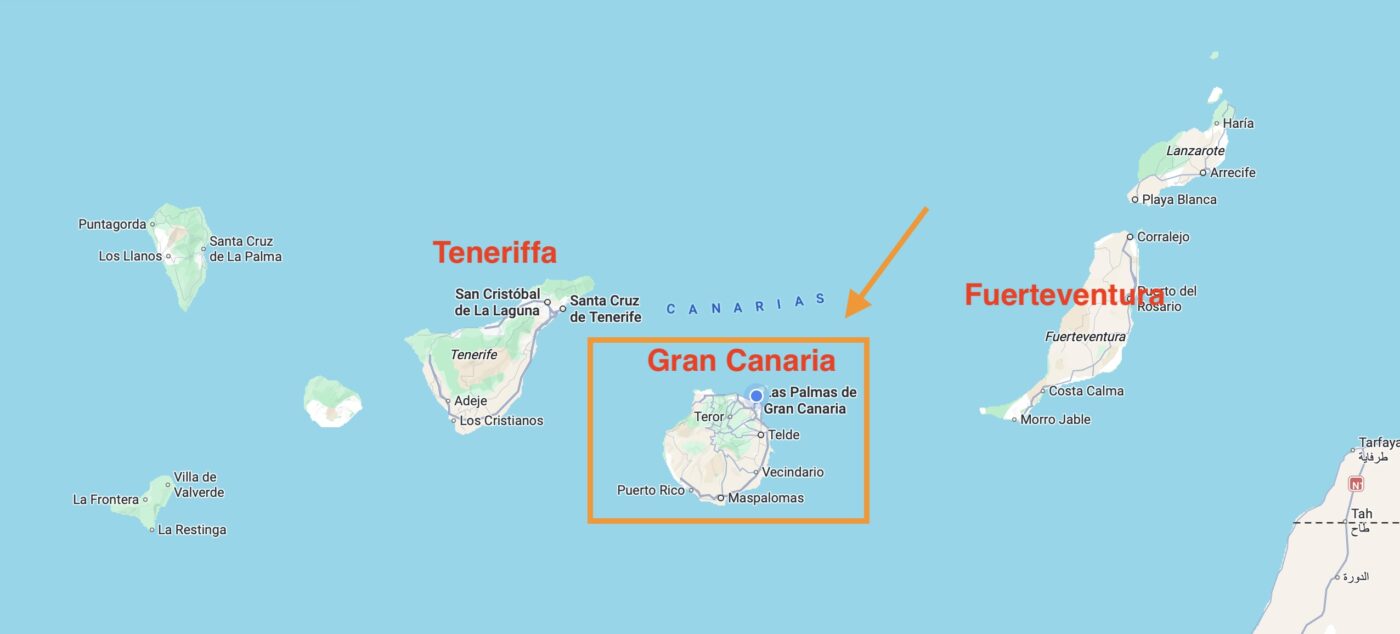
Map of the island:
Route to the blog:
About the island
Gran Canaria is the third-largest of the Canary Islands, after Tenerife and Fuerteventura. With a population of approximately 850,000 people living on an area of about 1,560 km², the island is one of the most densely populated in the Canary Islands.
The island offers an extraordinary variety of landscapes within a small area: dry and warm regions in the south, greener and wetter areas in the north, and a mountainous interior with deep gorges and striking rock formations.
Gran Canaria welcomes several million visitors each year.
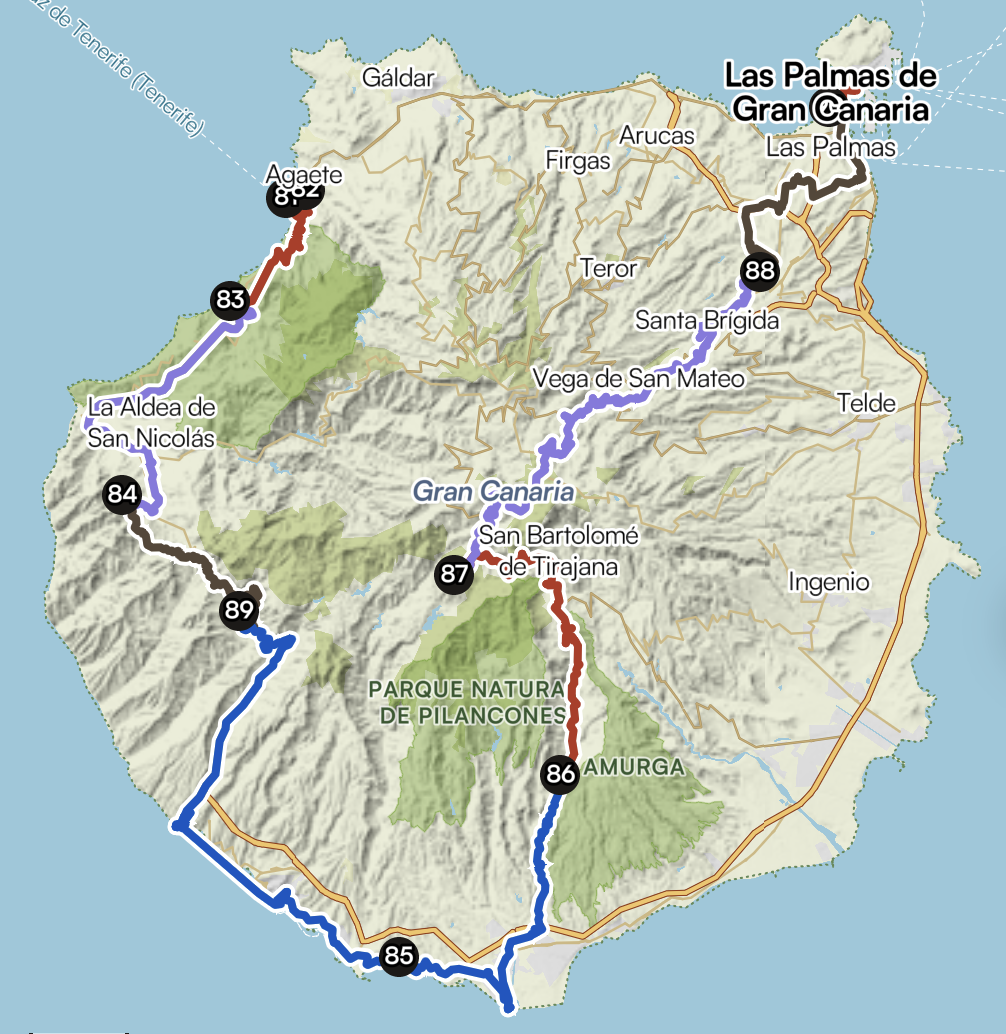
After an 80-minute ferry ride, we arrive in Agaete on Gran Canaria. To wait out the bulk of the approaching rain front in the dry, we decide to book two nights at a place to stay in this sleepy town. When we enter the room after self-check-in, we notice that it hasn’t been cleaned yet. We report this via the WhatsApp chat, which the accommodation uses as a communication channel. When we send pictures of the dirty room, we’re told that someone will be sent over immediately. After several more messages and nearly two hours of waiting, we follow up more closely and ask specifically when someone will arrive, since we desperately need a shower. The reply was “The ticket status is: Not yet viewed”…great, we’d been chatting with an AI the whole time—what a wonderful future 🤪. To make a long story short, after we finally managed to reach someone (a human) by phone, we were able to switch rooms and finally enjoy our well-deserved shower.
The break did us good; we continue along the old coastal road with little traffic and spectacular views. The weather is still unpredictable—it rains briefly every now and then—but the temperatures are quite pleasant at around 17 degrees. During a short stop, our eyes wander down to an abandoned beach with lots of bushes and trees, which seems like the perfect spot to sleep for the windy night. Besides, we’ve always wanted to camp right by the sea. After wading barefoot across three streams—sinking up to our knees in the water—we finally understood why the spot was so empty 😅. In our experience, though, the most beautiful spots always come at a price, and it’s worth it!


Ahead of us lies the Túnel de La Aldea, over 3 km long, which takes us from the rather rainy northwestern section toward the south. We’re pleasantly surprised by how bike-friendly the tunnel is; there’s a signal system that detects cyclists and then automatically closes the right lane to motorists, ensuring a safe ride for us—should we introduce that in the Gotthard Tunnel too 😂😉? We emerge on the other side into blazing sunshine. It’s always fascinating how much a 3-kilometer stretch can make a difference in terms of weather. Fortunately, we’re now back in a drier region.
Finding a place to camp today is proving very difficult; much of the area is fenced off and on private property. We spot a road with a no-entry sign for cars and motorcycles, which is often a welcome sign of a quiet spot to pitch our tent. We quickly check the route on the map and are pleased to see that the gravel road, with just a small detour, actually leads all the way to the pass we’ll be crossing anyway. It turns out that this route is much more beautiful than the one we originally planned, because the deserted road with its breathtaking views strongly reminds us of Georgia, which makes our hearts soar. In the distance, we see the original route with heavy traffic, and we’re even happier.
Once we reach the pass, we come back to the busy road, which takes us past the highlight, Los Azulejos de Veneguera. These are colorful rock faces whose green, bluish, and reddish hues look almost unnatural—hence the name “Azulejos,” which means “tiles.” The colors are created by volcanic rock that has been altered over time by heat and chemical processes. The greenish tones, in particular, come from minerals such as chlorite, which formed under high pressure and high temperatures. In addition to the extraordinary colors, the area also features numerous natural pools fed by waterfalls, inviting visitors to take a refreshing dip.
We want to take a day off in the beautiful Mogán region, but as is so often the case, we can’t find any affordable lodging—it’s unbelievable; everything is fully booked or completely overpriced. However, as we were driving down from the pass, we spotted a promising-looking spot far outside the village center, which we’re now heading toward. The path leads us over streams, rocks, and through the woods to a beautiful spot. A palm tree provides us with the necessary shade as well as a place to hang our 10-liter shower water bag, the stream supplies us with the water we need, and all of this with a view of the colorful rock walls of Los Azulejos de Veneguera. It could hardly be better, and we spend two nights there.


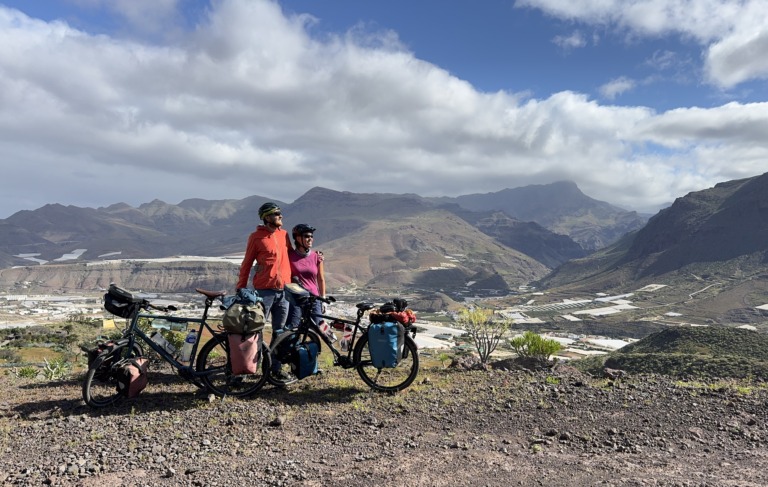


It’s a good thing we really took the time to enjoy the peace and quiet one last time, because now we’re heading south to Maspalomas, the most touristy spot on the island. We’re actually only there for one reason: we want to marvel at the famous sand dunes right on the coast. But when we see the crowds, we immediately do a 180-degree turn and decide to cycle straight back up into the mountains. It was good that we were able to ride part of the steep road in the late afternoon, since at that time all the day-trippers were returning to Maspalomas, leaving us with a clear path. We experienced the exact opposite the next morning, when we were overtaken in turn by huge groups of road cyclists, cars, and tour buses. We’ve never seen so many road cyclists in our lives! But we can well understand why so many cyclists choose this route, since the weather is often fantastic and the landscape, with its gorges and mountains, is simply incredibly beautiful.
After a night at a paradisiacal wild camping spot, we decided to spend the following night at an official free campsite at 1,220 meters above sea level. Fortunately, we had the place to ourselves, so we were able to shower before sunset—a good thing, too, as temperatures up here drop to a biting 4°C at night. Once again, we’re proud of our gear, which is prepared for almost any eventuality. Many people can’t enjoy these amazing campsites because they don’t have enough warm clothing or proper sleeping equipment with them. Of course, we have to lug all that extra weight around, but when you’re already carrying a paraglider, it doesn’t really make much of a difference anyway 😅.
The only piece of equipment giving us sleepless nights—in the truest sense of the word—is Beni’s sleeping pad. By now, it has so many holes from the fine, sharp-edged volcanic dust of the Canary Islands that we can no longer get it airtight. It barely lasts an hour before Beni “kisses the ground” and has to inflate it all over again.
The manufacturer, Therm-a-Rest, has already guaranteed a warranty replacement. However, the pad cannot be shipped directly to us because the Canary Islands are not part of the EU VAT area. Consequently, the mat is being sent to Beni’s father’s house, and he will forward it to us once we are back on the mainland. For now, we’re hurrying a bit to get to Las Palmas in the northeast of the island, where we hope to find a temporary solution.


The ride to Las Palmas is absolutely spectacular once again, as we get to race down a good 1,700 meters in elevation. Just like on the other islands, the northeast is generally cool, rainy, and lush green due to the northeast trade winds. The ticks like it too, and they literally swarm all over us on our last night in the tent before Las Palmas. Unfortunately, we don’t notice this until we’ve already set up the tent and are sitting inside—hordes of common wood ticks are crawling up the tent fabric. So every time we want to leave the tent, the two of us have to make sure we don’t bring any ticks back inside.
Once we arrive in Las Palmas, we enjoy a good meal, plan our onward journey to the next island, Fuerteventura, Beni goes paragliding, and we patch up Beni’s sleeping pad with duct tape.


For even more insight into our everyday cycling life, check out our latest video: